

My villain arc began innocently enough.
My daughter wanted to audition for the community musical. I did what I always do. I encouraged her with every growth mindset line in my school psych toolkit. You can do hard things! Embrace the challenge! You grow through what you go through!
She listened to all of it. She nodded thoughtfully. And then she said: “Great. Because I want you to do it with me. It’s a family thing.”
I said: “Baby girl, I can’t sing.”
She said: “Yet.”
She uno-reversed me with my own material!!! I had no defense.
So I auditioned. And at that audition, in front of only 3 human beings (after I have spoken to rooms of hundreds without breaking a sweat), I panicked. I forgot the words. I sang, to the tune of Poor Unfortunate Souls, “I forgot the worrrrrrrrds” off tune. I forgot the monologue even though it was written on the wall. I got so hot with nerves, I ripped off my sweatshirt and dramatically threw it across the room asked the director if I was having a hot flash, if I was just nervous, or if the room was eleventy-billion degrees. She said, “probably all three?”
I got a role anyway (apparently my audition was just the kind of chaotic energy they were looking for in casting a villain…ha!) I got the role the wicked stepmother, with two whole singing lines that triggered what I can only professionally describe as a “amygdala threat response” out of me. Two lines. So I took voice lessons for them. Practiced them like they were a dissertation defense.
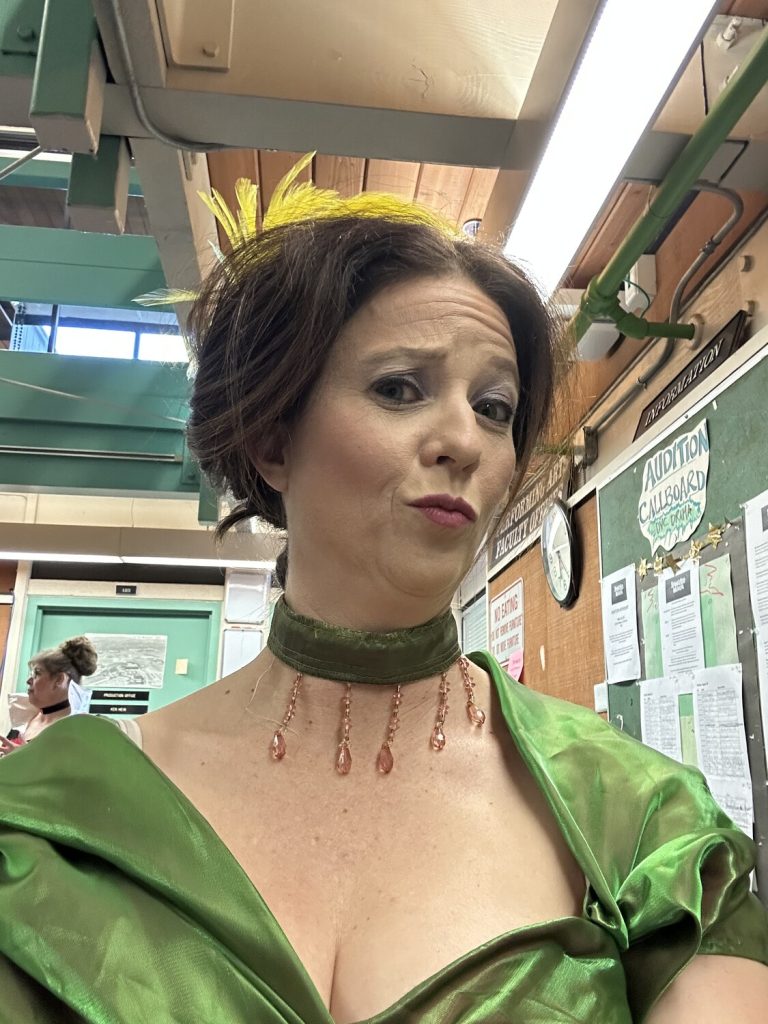
A feather in my cap for overcoming anxiety
I just auditioned again this spring. This time, I didn’t have a full physiological event! This year I am playing Mother Gothel, the villain who creepily brushes her fake daughter Rapunzel’s hair in a tower instead of getting botox.
Am I a strong singer now? No. Am I better? Yes. Am I still freaked the freak out to perform? Absolutely yes. But here’s what a year of voice lessons and two terrifying singing lines taught me: You grow through what you go through.
And here is what the whole experience has taught me about mental health (on a deep cellular level, not just in theory): It’s so important to remember the “beginner’s mind.”
What seems easy and completely doable to those of us with experience is actually really frickin’ scary when you’re new to it.
Standing in front of one person and singing sent me into brain stem in a way that standing in front of hundreds never has. And instead of judging myself harshly for that (which was my first instinct) I had to practice the thing I teach: Mistakes are how we learn and grow. Compassion for the beginner. Do your best and let go of the rest.
The next time a child shuts down, refuses to try, melts down at the starting line of something new, I remember what it felt like to forget the words. I remember sweating like a pig in a pig sweating contest. I remember the heart palpitations.
I remember that what looks small from the outside can feel enormous from the inside.
That’s being human. And during Mental Health Awareness Month, we can normalize that.
Now, let’s talk about one of the most underrated tools we have for moving through it: the arts (and you can trust me on this even though I’m a villain now. After all, Mother knows best).

🎭 Benefits of the Arts on Mental Health
The most popular Ted Talk of 2025 has probably the best title ever: “The Case for Making Art When the World is On Fire.” In the talk, writer Amie McNeed makes the case that making art isn’t self-indulgent — it’s an essential, radical act of creation.
There’s powerful evidence to back this up. Here’s what the researchers say about the power of the arts on mental health:
For adults, there is reliable evidence that music and singing are associated with reduced anxiety, improved mood, and reduced risk of depression. And a landmark review commissioned by the World Health Organization synthesized over 3,000 studies and found that engagement with the arts — theatre, music, dance, visual arts — is associated with reduced anxiety, reduced depression, and improved wellbeing across the lifespan. Not as a replacement for treatment, but as a genuine, evidence-based pathway to feeling more human.
For kids and teens, preliminary studies suggest group singing reduces cortisol levels in children and adolescents, with in-person singing showing the strongest effect. And when it comes to theatre specifically, multiple studies of adolescents in drama programs show improvements in mental health, self-efficacy, communication skills, and empathy — with one of the most consistent findings being something any educator will recognize: kids in drama programs grow in confidence and become more willing to try new things.
I can’t even being to tell you the joy that being a part of a musical with my daughters has given me. When things get hard at work, I can look forward to “playing” (which, incidentally, sends my nervous system a signal that we are SAFE–I mean, we only play when we are safe. Ever see animals romping around and playing if there’s danger around?).
Which means my daughter did not just uno-reverse me with my own growth mindset material. She prescribed me an evidence-based mental health intervention.
As it turns out, in this story, it was my daughter who knew best all along.
🍃 Microhabit of the Month: The Control Audit (An Elsa and Anna Framework for Not Losing Your Mind in May)
May in schools is a lot. Testing season. End-of-year IEPs. Spring fever. Budget anxiety. Pink slips. The collective exhaustion of a system that has been running hard since September. It’s the time of year when everything feels urgent and very little feels within your control.
And it lands right in the middle of Mental Health Awareness Month, which is either perfectly timed or deeply ironic depending on how you look at it.
So here’s your microhabit: the Control Audit.
The premise is simple (and based in play and musicals once again, because WHY NOT?) When you feel overwhelmed, anxious, or like you’re white-knuckling it through the week, you pause and ask two questions. One from Elsa. One from Anna.
❄️ The Elsa Question: What do I need to let go of right now?
Elsa’s whole arc — underneath all the ice and the isolation and the big feelings — is about learning that some things cannot be controlled, and fighting them only makes them worse. The budget cut is happening. The policy changed. Don’t pick a fight with reality. Acknowledge it. Let it go.
This is not giving up. It is one of the most important mental health skills we have: identifying what is simply not yours to fix right now. Do your best and let go of the rest.
🥾The Anna Question: What is the next right step?
Anna doesn’t have a plan. She never has a plan. She has one foot and then the next foot and a stubborn refusal to stop moving. When everything feels out of control, Anna’s question cuts through the noise is “what is the next right step I actually have control over right now?”
Maybe it’s sending one email. Making one phone call. Taking three breaths before the next meeting. Drinking the water that’s been sitting on your desk since 7am.
The Control Audit is not about solving the big thing. It’s about not letting the big thing convince you that nothing is within your reach. Because something always is.
If you want to see how my singing is coming along, here’s a TikTok about it. (You can also check it out on Instagram if you don’t have TikTok)
Elsa looks like a teacher in May.
🐻 BEARY BIG NEWS: Teddy Talks® Season 1 Wrapped (and Season 2 is Done Hibernating!)
Mental Health Awareness Month isn’t just for adults. Children’s Mental Health Awareness Week reminds us that mental health starts early. And so does Teddy Talks® (our playful children’s podcast we launched in collaboration with the incredible creative geniuses at GoKidGo and Generation Mindful.)
Teddy Talks® was build because we have all experienced that moment when a child is hurting and you have absolutely no idea what to say.
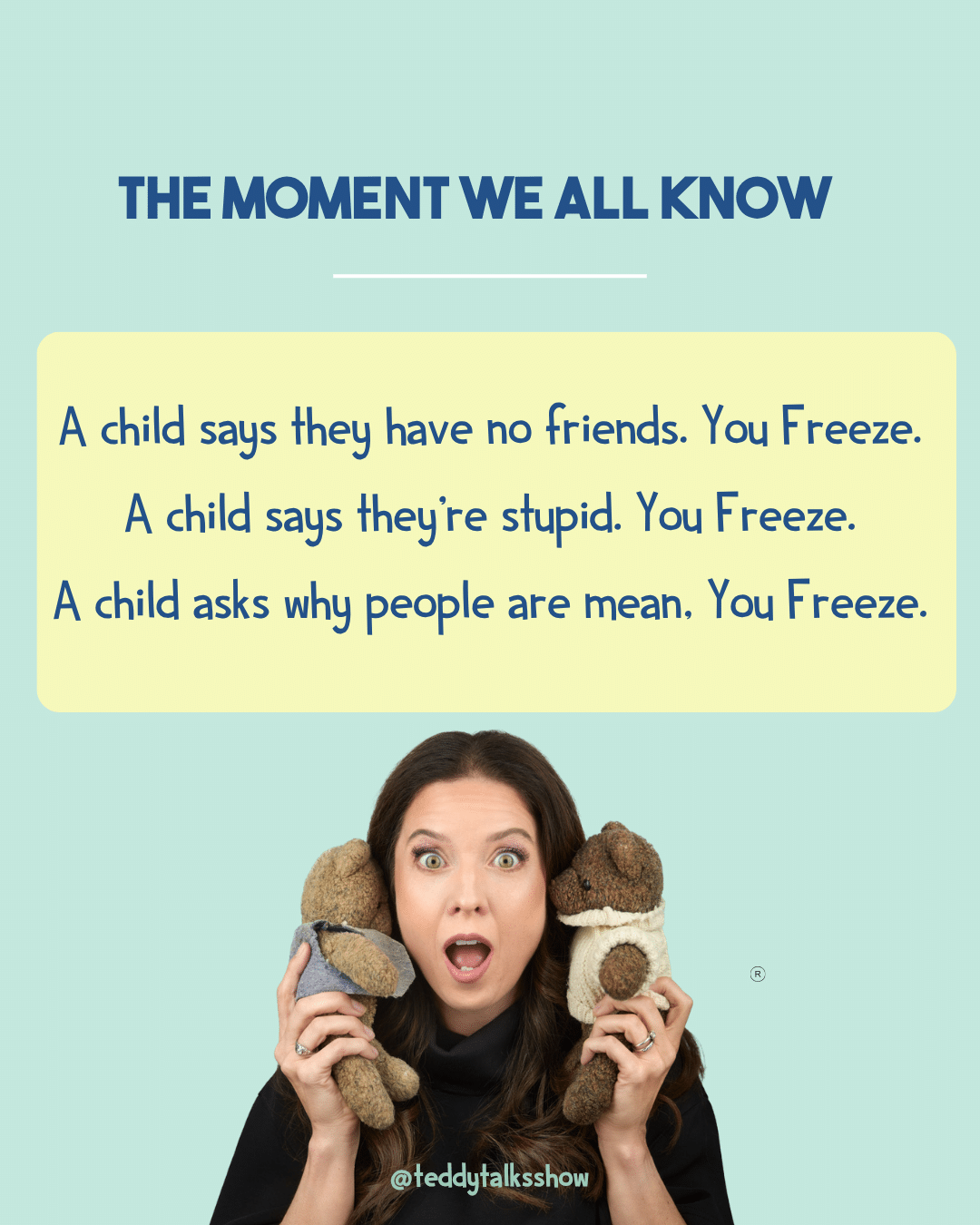
You’re not failing them. You just haven’t had the words modeled for you. Yet.
That’s exactly why Teddy Talks® exists. Co-hosted by me and our two fuzzy emotional wellness ambassadors Grizzle and Grizzlette, Teddy Talks is a children’s podcast that models the hard conversations out loud, through story, song, expert guests (and a healthy dash of bear puns) so that kids and the adults who love them can find the words together.
Season 1 covered 15 episodes of the conversations we need to be having:
- What do you say when a child is being teased?
- How do you explain scary things in the news to young children?
- What do you say when a child gives up easily (or is super hard on themselves)? And so much more.
Each episode is 15-20 minutes and comes with free downloadable activities at teddytalks.com which are perfect for calm-down corners, therapy sessions, morning meetings, or a screen-free play time for parents and caregivers.
It’s not just for kids who struggle! It’s 20 minutes of magic that gives you words you can use with kids for years, in any tricky situation. Perfect for parents, teachers, therapists, and anyone who wants to support children’s mental health.

This Mental Health Awareness Month, the most powerful thing you can do for the children in your life is to talk it out and play it out together. That’s what Teddy Talks® is for. And even though school psychologists don’t write actual prescriptions, here’s mine for connection (feel free to share!):
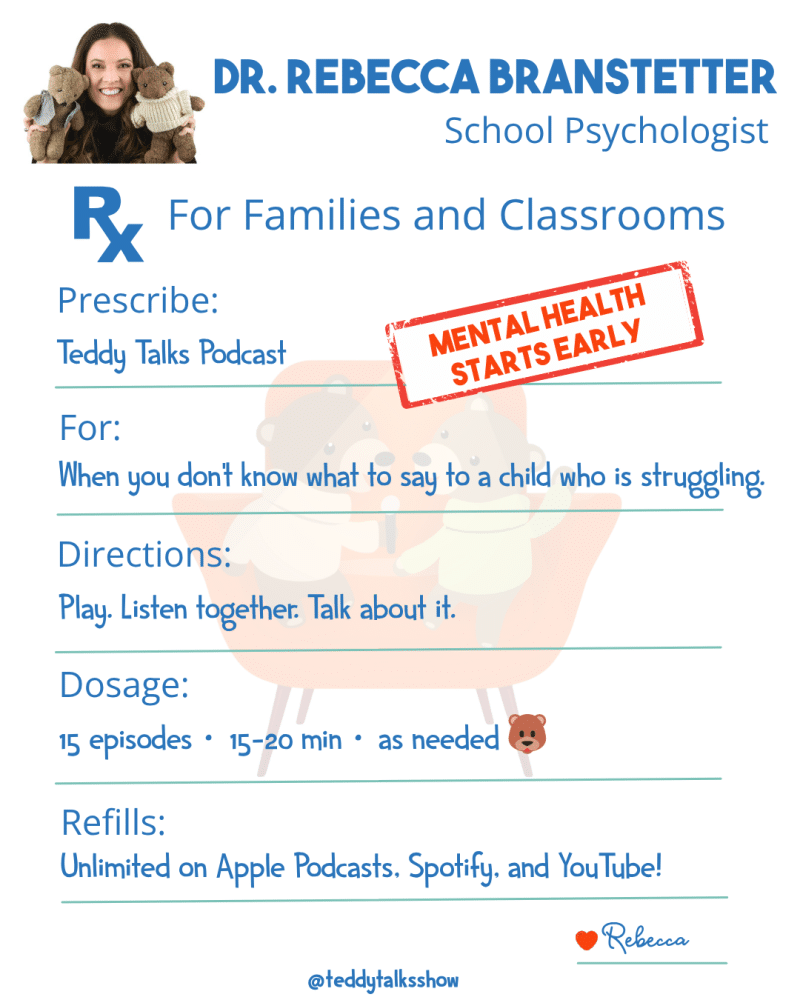
Season 2 is coming soon! In the meantime, catch up on Season 1 now on Apple Podcasts, Spotify, or YouTube. And be sure to follow @teddytalksshow on Instagram or Facebook for updates.
FREE MINDFUL MAY TRAINING
Fresh off my villain era and fully committed to bringing theatre vibes to your mental health toolkit, this month’s Mindful May training is the crossover episode nobody asked for but everybody needs. We did this training live in our private Thriving Students Collective Community last week and I can’t even tell you the amazing emails I’ve received this week about how little shifts have had a huge impact on stress reduction already!
So we want to share with the larger education community what we learned! We learned how to vanquish villains courtesy of Harry Potter. We explored mindfulness-based stress reDUCKtion. Yes, a comically sized duck is involved. And we will did the Control Audit together, because May in schools practically requires it.
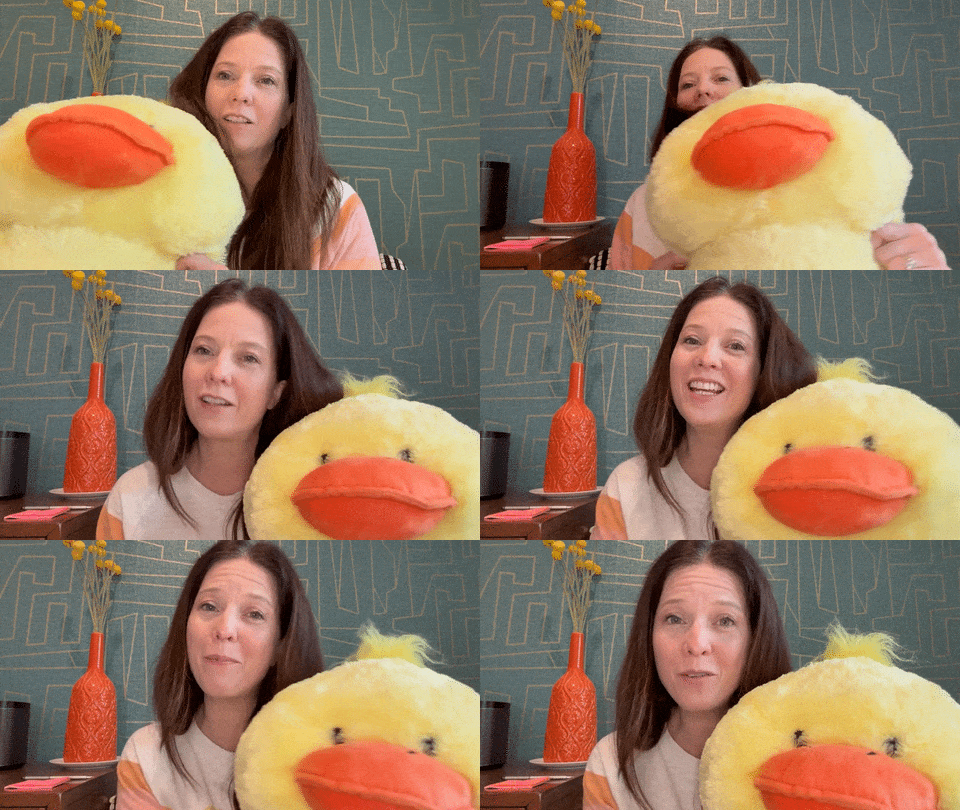
Get your ducks in a row this month with mindful micro-habits
If you are an educator trying to finish this school year without completely running on fumes, this one is for you!
Click HERE for our FREE Mindful May Training! Includes free Mindful May workbook (duck not included).
📱TikTok of the Month
If you have been around here for a while, you know: I believe in humor, play, and bringing joy in through the side door, even if times are challenging. Laughter is a legitimate mental health intervention and I will die on that hill. We can be light while still acknowledging the dark.
And this month, in the spirit of Mental Health Awareness Month, I got real about my own personal journey out of burnout. Because the struggle is real. And so is the way out.
Watch it on TikTok or Instagram — stay to the end for the transformation…
If it resonates, share it with someone who needs to see that the people who talk about mental health professionally are also just… people. Doing the work. Some days more gracefully than others. One next right step at a time.
Final Thoughts…
Here’s what I want to leave you with this May:
Mother knows best. Except when daughter knows best. 🙂 And sometimes the most important thing a school psychologist who has spent twenty years teaching growth mindset can do is get uno-reversed by her own kid, forget the words at an audition, have a full physiological event in front of three strangers, and come back the next year anyway.
That is beginner’s mind. That is growth mindset in action.
The world is asking a lot of all of us right now. The kids in your care are carrying more than they should have to. And so are you. Mental Health Awareness Month is a good reminder that the caregivers need care too. That letting go and taking the next right step are not just things we say, they are things we have to practice, badly and imperfectly and sometimes off-key, just like everyone else.
What is your next right step? What can you do to step outside of your comfort zone for your growth? What is the scary but secretly super fun thing you’ve been wanting to do but haven’t tried yet?
Underwater basket weaving? Horseback riding? Pickleball? Bollywood Dance? Whatever it is, just take one step to start researching how to bring that joy and exciting new spark into your world. I promise, it’s worth it.
You grow through what you go through. Even the villain era. Especially the villain era.
See you in June, where I will be reporting back on opening night and whether Mother Gothel gets a redemption arc. 🧡

If you’re interested in being a part of the Thriving Students Collective community and would like more information about how to bring the Thriving Students Platform to your school or district, CLICK HERE to connect with us.
Want more K12 News You Can Use? Subscribe here!
___________
Dr. Rebecca Branstetter is a school psychologist and founder of The Thriving Students Collective, which provides professional development, engaging online courses, and a supportive online communitythat prioritizes whole-school wellness and equips educators and parents with practical tools to empower every learner’s success. She also has a TikTok account all about burnout prevention in K12 that her teen daughter has endorsed as “Cringe, but good dancing.”